
Triangles
Quiz Summary
0 of 40 Questions completed
Questions:
Information
You have already completed the quiz before. Hence you can not start it again.
Quiz is loading…
You must sign in or sign up to start the quiz.
You must first complete the following:
Results
Results
0 of 40 Questions answered correctly
Your time:
Time has elapsed
You have reached 0 of 0 point(s), (0)
Earned Point(s): 0 of 0, (0)
0 Essay(s) Pending (Possible Point(s): 0)
Categories
- Not categorized 0%
- 1
- 2
- 3
- 4
- 5
- 6
- 7
- 8
- 9
- 10
- 11
- 12
- 13
- 14
- 15
- 16
- 17
- 18
- 19
- 20
- 21
- 22
- 23
- 24
- 25
- 26
- 27
- 28
- 29
- 30
- 31
- 32
- 33
- 34
- 35
- 36
- 37
- 38
- 39
- 40
- Current
- Review / Skip
- Answered
- Correct
- Incorrect
-
Question 1 of 40
1. Question
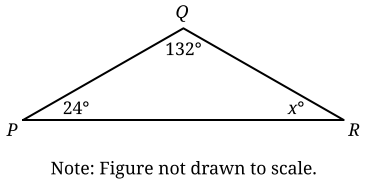
\(\text{In the triangle shown, }PQ=QR\text{. What is the value }x?\)
CorrectIncorrect -
Question 2 of 40
2. Question
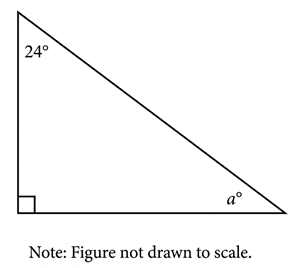
\(\text{In the right triangle shown, what is the value of }a?\)
CorrectIncorrect -
Question 3 of 40
3. Question
\(\begin{aligned}
&\text{In triangle }ABC\text{, the measure of angle }B\mathrm{~is~}52°\text{ and the measure of angle }C\text{ is }17°.\\
&\text{What is the measure of angle }A ?\end{aligned}\)CorrectIncorrect -
Question 4 of 40
4. Question
\(\begin{aligned}&\mathrm{In~}\triangle JKL\text{, the measures of both }\angle J\mathrm{~and~}\angle K\text{ are equal and the measure of }\angle L\mathrm{~is~}136°.\\&\text{What is the measure of }\angle J?\end{aligned}\)
CorrectIncorrect -
Question 5 of 40
5. Question
\(\mathrm{In~}\triangle FGH\text{, the measures of }\angle F\mathrm{~and~}\angle G\text{ are each }39°\text{. What is the measure of }\angle H?\)
CorrectIncorrect -
Question 6 of 40
6. Question
\(\begin{aligned}
&\mathrm{In~}\triangle RST\text{, the measure of }\angle R\mathrm{~is~}63°.\text{ Which of the following could be the measure,}\\
&\text{in degrees, of }\angle S?\end{aligned}\)CorrectIncorrect -
Question 7 of 40
7. Question
\(\begin{aligned}&\text{In a triangle }ABC\text{, the measure of angle }A\mathrm{~is~}48°\text{, the measure of angle }B\mathrm{~is~}90°,\\&\text{and the measure of angle }C\mathrm{~is~}\left(\frac{k}{2}\right)^{\circ}\text{. What is the value of }k?\end{aligned}\)
CorrectIncorrect -
Question 8 of 40
8. Question
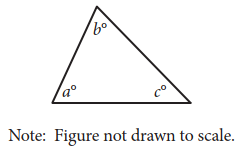
\(\begin{aligned}&\text{In the triangle above, }a=34\text{. What is the value of }b+c?\end{aligned}\)
CorrectIncorrect -
Question 9 of 40
9. Question
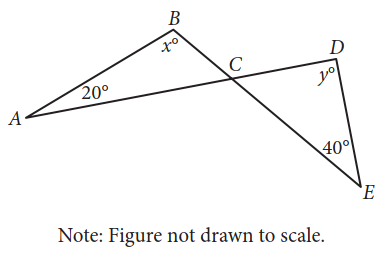
\(\text{In the figure above, }\overline{AD}\text{ intersects }\overline{BE}\text{ at C. If }x=100,\text{what is the value of }y?\)
CorrectIncorrect -
Question 10 of 40
10. Question
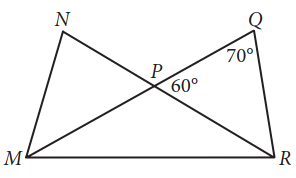
\(\begin{aligned}
&\mathrm{In~the~figure~above},\overline{MQ}\mathrm{~and~}\overline{NR}\text{ intersect at point~}P,NP=QP,\mathrm{and~}MP=PR.\\
&\text{What is the measure, in degrees, of }\angle QMR?\end{aligned}\)CorrectIncorrect -
Question 11 of 40
11. Question
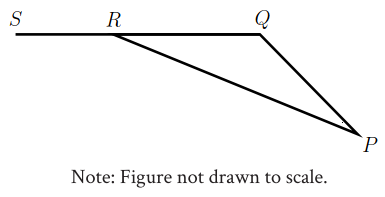
\(\begin{aligned}&\text{In triangle }PQR,\overline{QR}\text{ is extended to point }S.\text{ The measure of }\angle PQR\mathrm{~is~}142°\text{, and the}\\&\text{measure of }\angle PRS\mathrm{~is~}166°\text{. What is the measure of }\angle QPR?\end{aligned}\)
CorrectIncorrect -
Question 12 of 40
12. Question
\(\begin{aligned}&\text{In triangle }PQR\text{, the measure of angle }P\mathrm{~is~}(3x+5)°\text{, the measure of angle }Q\mathrm{~is~}(2x+9)°,\\
&\text{and the measure of angle }R\mathrm{~is~}(4y+5)°\text{. If side }QR\text{ is extended through point }R\text{ to point }S,\\&\text{and the measure of angle }PRS\mathrm{~is~}(x+y)°\text{, what is the value of }x+y?\end{aligned}\)CorrectIncorrect -
Question 13 of 40
13. Question
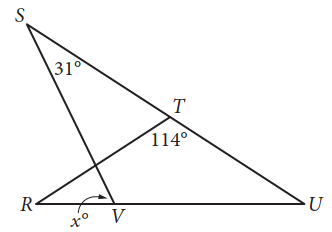
\(\text{In the figure above, }RT=TU\text{. What is the value of }x?\)
CorrectIncorrect -
Question 14 of 40
14. Question
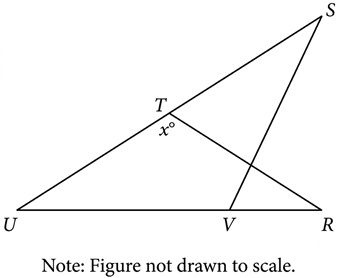
\(\begin{aligned}
&\text{In the figure, }RT=TU\text{, the measure of angle }VST\mathrm{~is~}23°\text{, and the}\\&\text{measure of angle }RVS\mathrm{~is~}34°\text{. What is the value of }x?\end{aligned}\)CorrectIncorrect -
Question 15 of 40
15. Question
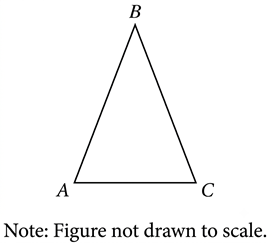
\(\begin{aligned}&\text{In the figure shown, the length of }\overline{AB}\text{ is 66. Which statement provides sufficient information}\\&\text{to prove that triangle }ABC\text{ is isosceles?}\end{aligned}\)
CorrectIncorrect -
Question 16 of 40
16. Question
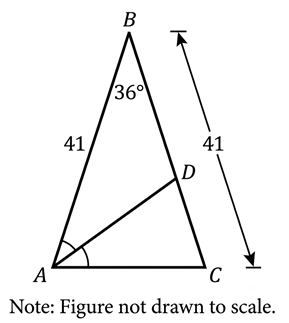
\(\begin{aligned}
&\text{For isosceles triangle }ABC,AB=BC=41,\text{ the measure of angle }ABC\text{ is 36°, point }D\mathrm{~lies}\\
&\mathrm{on~}\overline{BC},\mathrm{~and~}\angle BAC\text{ is bisected by }\overline{AD}.\text{ Which of the following statements must be true?}\end{aligned}\)CorrectIncorrect -
Question 17 of 40
17. Question
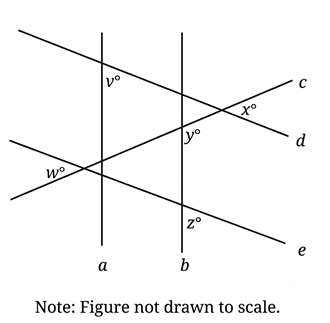
\(\begin{aligned}
&\mathrm{In~the~figure,~parallel~lines~}a\mathrm{~and~}b\text{ are intersected by lines }c,d,\mathrm{and~}e.\mathrm{~If~}z=49,y=136,\\&\mathrm{and~}v<z,\text{which statement about }x\mathrm{~and~}w\mathrm{~must~be~true?}\end{aligned}\)CorrectIncorrect -
Question 18 of 40
18. Question
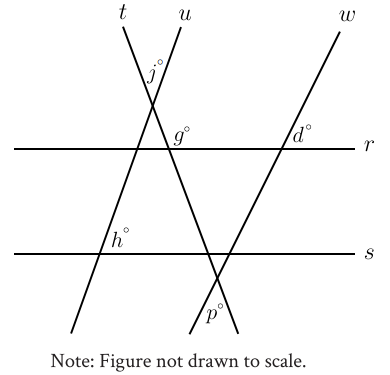
\(\begin{aligned}&\text{In the figure, parallel lines }r\text{ and }s\text{ are intersected by lines }t,u,\mathrm{~and~}w.\mathrm{~If~}d=42,g=143,\\&\mathrm{and~}h>d,\text{which statement about }j\mathrm{~and~}p\mathrm{~must~be~true?}\end{aligned}\)
CorrectIncorrect -
Question 19 of 40
19. Question
\(\begin{aligned}&\text{The triangle inequality theorem states that the sum of any two sides of a triangle must be}\\&\text{greater than the length of the third side, If a triangle has side lengths of 8 and 13, which}\\&\text{inequality represents the possible lengths, }x\text{, of the third side of the triangle?}\end{aligned}\)
CorrectIncorrect -
Question 20 of 40
20. Question
\(\begin{aligned}
&\text{The length of two sides of a triangle are 4 centimeters and 6 centimeters. If the perimeter of}\\
&\text{the triangle is 18 centimeters, what is the length, in centimeters, of the third side of this triangle?}\end{aligned}\)CorrectIncorrect -
Question 21 of 40
21. Question
\(\begin{aligned}
&\text{The perimeter of an isosceles triangle 83 inches. Each of the two congruent sides of the}\\&\text{triangle has a length of 24 inches. What is the length, in inches, of the third side?}\end{aligned}\)CorrectIncorrect -
Question 22 of 40
22. Question
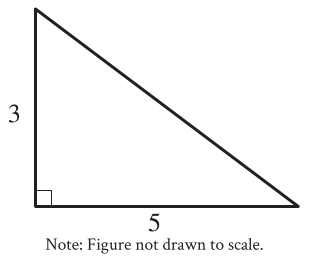
\(\begin{aligned}
&\text{The figure shows the lengths, in inches, of two sides of a right triangle. What is the area of}\\
&\text{the triangle, in square inches?}\end{aligned} \)CorrectIncorrect -
Question 23 of 40
23. Question
\(\begin{aligned}
&\text{A triangle has a base length of 82 centimeters and a height of 164 centimeters. What is}\\
&\text{the area, in square centimeters, of the triangle?}\end{aligned}\)CorrectIncorrect -
Question 24 of 40
24. Question
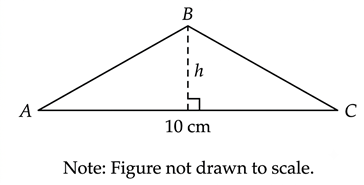
\(\begin{aligned}
&\text{The area of triangle }ABC\text{ is 220 square centimeters. What is the height }h\text{, in centimeters of}\\
&\text{this triangle?}\end{aligned}\)CorrectIncorrect -
Question 25 of 40
25. Question
\(\begin{aligned}
&\text{The area of a triangle is equal to }x^{2}\text{ square centimeters. The length of the base of the}\\&\text{triangle is }2x+6\text{ centimeters, and the height of the triangle is }x-2\text{ centimeters. }\\&\text{What is the values of }x?\end{aligned}\)CorrectIncorrect -
Question 26 of 40
26. Question
\(\begin{aligned}
&\text{The area of a triangle is 270 square centimeters. The length of the base of the triangle is }\\
&\text{12 centimeters greater than the height of the triangle. What is the height, in centimeters, }\\&\text{of the triangle?}\\\end{aligned}\)CorrectIncorrect -
Question 27 of 40
27. Question
\(\begin{aligned}&\text{The area of a triangle is 224 square inches. The length of the base of the triangle, in inches, is}\\&\text{the sum of 15 and a positive number }d\text{, and the height, in inches, is 3 less than }d\text{. What is the}\\&\text{value of }d?\end{aligned}\)
CorrectIncorrect -
Question 28 of 40
28. Question
\(\begin{aligned}
&\text{A right triangle has sides of length }2\sqrt{2},6\sqrt{2}\text{, and}\sqrt{80}\text{ units. What is the area of}\\
&\text{the triangle, in square units?}\end{aligned}\)CorrectIncorrect -
Question 29 of 40
29. Question
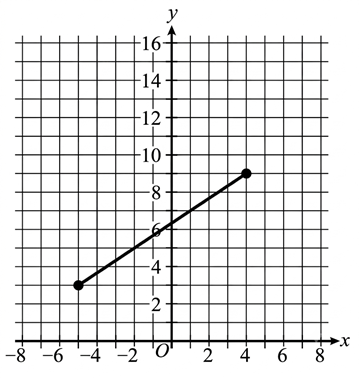
\(\begin{aligned}&\text{The line segment shown in the }xy\text{-plane represents one of the legs of a right triangle. The}\\&\text{area of this triangle is }48\sqrt{13}\text{ square units. What is the length, in units, of the other leg of}\\&\mathrm{this~triangle?}\end{aligned}\)
CorrectIncorrect -
Question 30 of 40
30. Question
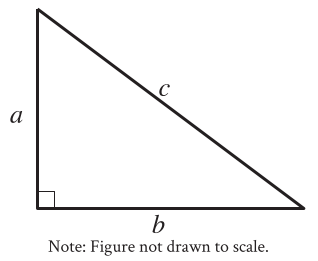
\(\text{For the right triangle shown, }a=4\text{ and }b=5\text{. Which expression represents the value of c?}\)
CorrectIncorrect -
Question 31 of 40
31. Question
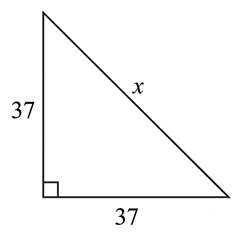
\(\text{In the right triangle shown, what is the value of }x?\)
CorrectIncorrect -
Question 32 of 40
32. Question
\(\begin{aligned}&\text{In triangle }ABC,\mathrm{angle~}B\text{ is a right angle. The length of side }AB\mathrm{~is~}10\sqrt{39}\text{ and the length of}\\&\mathrm{side~}BC\mathrm{~is~}24\sqrt{39}.\text{ What is the length of side }AC?\end{aligned}\)
CorrectIncorrect -
Question 33 of 40
33. Question
\(\begin{aligned}
&\text{One leg of a right triangle has a length of 43.2 millimeters. The hypotenuse of the triangle has}\\
&\text{a length of 196.8 millimeters. What is the length of the other leg of the triangle, in millimeters?}\end{aligned}\)CorrectIncorrect -
Question 34 of 40
34. Question
\(\begin{aligned}
&\text{A right triangle has legs with lengths of 24 centimeters and 21 centimeters. If the length of this}\\
&\text{triangle’s hypotenuse, in centimeters, can be written in the form 3}\sqrt{d},\mathrm{where~}d\mathrm{~is~an~integer,}\\&\text{what is the value of }d ?\end{aligned}\)CorrectIncorrect -
Question 35 of 40
35. Question
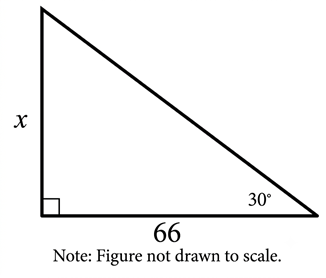
\(\text{In the triangle shown, what is the value of }x?\)
CorrectIncorrect -
Question 36 of 40
36. Question
\(\begin{aligned}
&\text{An equilateral triangle has a height of 47}\sqrt{3}\text{ units. What is the length, in units, of one side of}\\
&\text{this triangle?}\end{aligned}\)CorrectIncorrect -
Question 37 of 40
37. Question
\(\begin{aligned}
&\text{The perimeter of an equilateral triangle is 624 centimeters. The height of this triangle is }k\sqrt{3}\\
&\text{centimeters, where }k\text{ is a constant. What is the value of }k?\end{aligned}\)CorrectIncorrect -
Question 38 of 40
38. Question
\(\begin{aligned}
&\text{An isosceles right triangle has a hypotenuse of length 58 inches. What is the perimeter,}\\
&\text{in inches, of this triangle?}\end{aligned}\)CorrectIncorrect -
Question 39 of 40
39. Question
\(\begin{aligned}
&\text{An isosceles right triangle has a perimeter of }94+94\sqrt{2}\text{ inches. What is the length, in inches, }\\
&\text{of one leg of this triangle?}\end{aligned}\)CorrectIncorrect -
Question 40 of 40
40. Question
\(\begin{aligned}
&\text{The perimeter of an isosceles triangle is }38+38\sqrt{2}\text{ inches. What is the length, in inches,}\\
&\text{of the hypotenuse of this triangle?}\end{aligned}\)CorrectIncorrect