Transformations
Quiz Summary
0 of 24 Questions completed
Questions:
Information
You have already completed the quiz before. Hence you can not start it again.
Quiz is loading…
You must sign in or sign up to start the quiz.
You must first complete the following:
Results
Results
0 of 24 Questions answered correctly
Your time:
Time has elapsed
You have reached 0 of 0 point(s), (0)
Earned Point(s): 0 of 0, (0)
0 Essay(s) Pending (Possible Point(s): 0)
Categories
- Not categorized 0%
- 1
- 2
- 3
- 4
- 5
- 6
- 7
- 8
- 9
- 10
- 11
- 12
- 13
- 14
- 15
- 16
- 17
- 18
- 19
- 20
- 21
- 22
- 23
- 24
- Current
- Review / Skip
- Answered
- Correct
- Incorrect
-
Question 1 of 24
1. Question
\(\begin{aligned}&\text{The function }f\text{ is defined by }f(x)=7x^{3}.\text{ In the }xy\text{-plane, the graph of }y=g(x)
\\&\text{is the result of shifting the graph of }y=f(x)\text{ down 2 units. Which equation }\\&\text{defines function }g?\end{aligned}\)CorrectIncorrect -
Question 2 of 24
2. Question
\(\begin{aligned}
&\text{In the }xy\text{-plane, the graph of the equation }y=9^{x}\text{ is translated 8 units down. What is}\\&\mathrm{an~equation~of~the~resulting~graph?}\end{aligned}\)CorrectIncorrect -
Question 3 of 24
3. Question
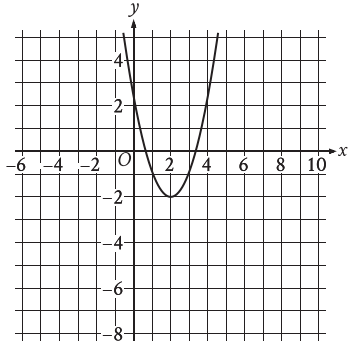
\(\text{The graph shown will be translated up 4 units. Which of the following will be the resulting graph?}\)
CorrectIncorrect -
Question 4 of 24
4. Question
\(\begin{aligned}
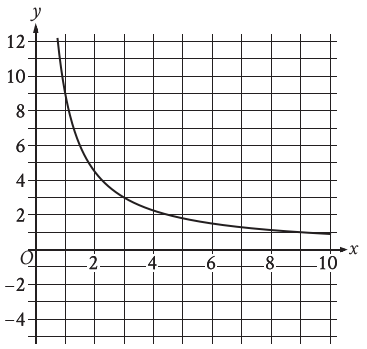
&\text{The graph of the rational function }f\text{ is shown, where }y=f(x)\text{ and }x\geq0.\text{ Which of }\\&\text{the following is the graph of }y=f(x)+5,\text{ where }x\geq0?\end{aligned}\)CorrectIncorrect -
Question 5 of 24
5. Question
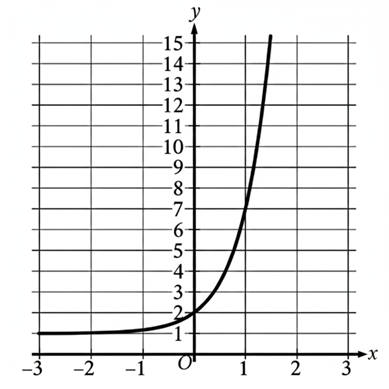
\(\text{The graph of }y=f(x)+1\text{ is shown. Which equation defines the function }f?\)
CorrectIncorrect -
Question 6 of 24
6. Question
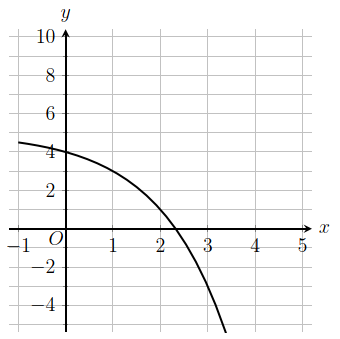
\(\text{The graph of }y=f(x)+2\text{ is shown. Which equation defines function }f?\)
CorrectIncorrect -
Question 7 of 24
7. Question
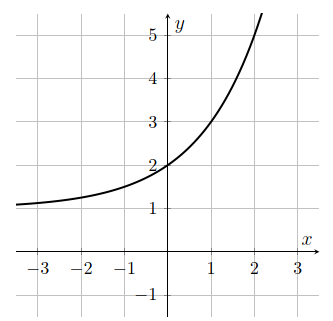
\(\begin{aligned}&\text{The graph of }y=f(x)-1\text{ is shown. Which equation could define function }f?\end{aligned}\)
CorrectIncorrect -
Question 8 of 24
8. Question
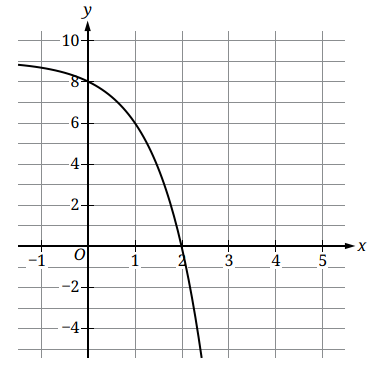
\(\begin{aligned}&\text{The graph of }y=f(x)+4\text{ is shown. Which equation defines function }f?\end{aligned}\)
CorrectIncorrect -
Question 9 of 24
9. Question
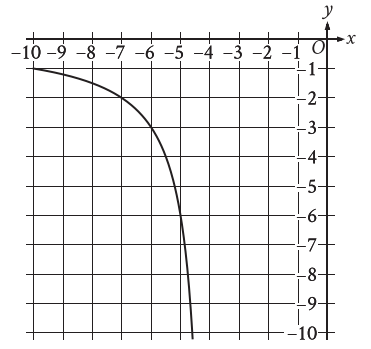
\(\begin{aligned}
&\text{The rational function }f\text{ is defined by an equation in the form }f(x)={\frac{a}{x+b}},\\&\mathrm{where~}a\mathrm{~and~}b\text{ are constants}.\text{ The partial graph of }y=f(x)\text{ is shown. If}\\&g(x)=f(x+4),\text{which equation could define function }g?\end{aligned}\)CorrectIncorrect -
Question 10 of 24
10. Question
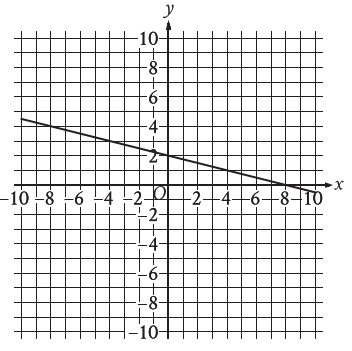
\(\begin{aligned}&\text{The graph of }y=f(x)+14\text{ is shown. Which equation defines function }f?\end{aligned}\)
CorrectIncorrect -
Question 11 of 24
11. Question
\(\text{The graph of }y=f(x)-11\text{ is shown}.\)
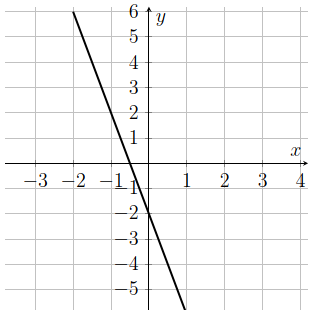
\(\text{Which equation defines the linear function }f?\)
CorrectIncorrect -
Question 12 of 24
12. Question
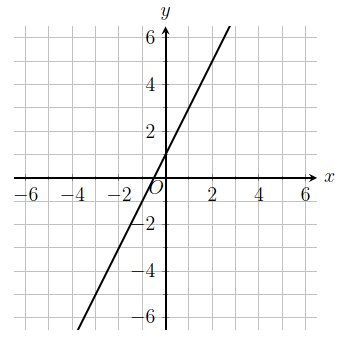
\(\text{The graph of }y=f(x)\text{ is shown. What is the }y\text{-intercept of the graph of }y=f(x)+13?\)
CorrectIncorrect -
Question 13 of 24
13. Question
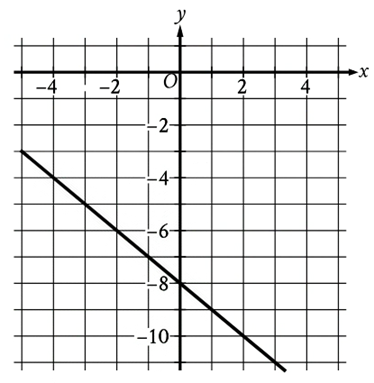
\(\begin{aligned}
&\text{The graph of the linear function }y=f(x)-19\text{ is shown. If }c\text{ and }d\text{ are positive constants,}\\&\text{which equation could define }f?\end{aligned}\)CorrectIncorrect -
Question 14 of 24
14. Question
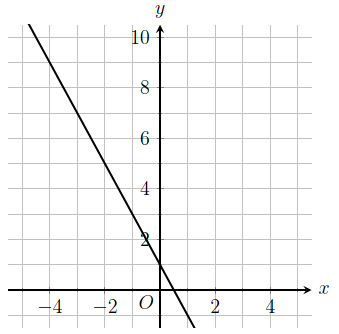
\(\begin{aligned}
&\text{The graph of the linear function }y=f(x)+11\text{ is shown. If }c\text{ and }d\text{ are positive constants,}\\&\text{which equation could define }f?\end{aligned}\)CorrectIncorrect -
Question 15 of 24
15. Question
\(\begin{aligned}&~~~~~~~~~~~~~~~~~~~~~~~~~~~~~~~~~~~~~~~~~~~~~g(x)=3(16x-17)\\
&\text{What is the }y\text{-coordinate of the }y\text{-intercept}\text{ of the graph of }y=g(x)-5\\&\text{in the }xy\text{-plane?}\end{aligned}\)CorrectIncorrect -
Question 16 of 24
16. Question
\(\begin{aligned}&\text{The function }f\text{ is defined by }f(x)=(x-6)(x-2)(x+6).\text{ In the }xy\text{-plane, the}\\&\text{graph of }y=g(x)\text{ is the result of translating the graph of }y=f(x)\text{ up }4\text{units. }\\&\text{What is the value of }g(0)?\end{aligned}\)
CorrectIncorrect -
Question 17 of 24
17. Question
\(\begin{aligned}&\text{The function }f\text{ is defined by }f(x)=(x-9)(x-6)(x-5).\text{ In the }xy\text{-plane, the}\\&\text{graph of }y=g(x)\text{ is the result of translating the graph of }y=f(x)\text{ up }4\text{units. }\\&\text{What is the value of }g(0)?\end{aligned}\)
CorrectIncorrect -
Question 18 of 24
18. Question
\(\begin{aligned}
&\text{The graph of 9}x-10y=19\text{ is translated down 4 units in the }xy\text{-plane. What is the }\\&x\text{-coordinate of the }x\text{-intercept of the resulting graph?}\end{aligned}\)CorrectIncorrect -
Question 19 of 24
19. Question
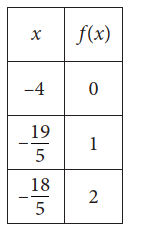
\(\begin{aligned}
&\text{For the linear function }f\text{, the table shows three values of }x\text{ and their corresponding}\\&\text{values of }f(x).\text{ If }h(x)=f(x)-13,\text{ which equation defines }h?\end{aligned}\)CorrectIncorrect -
Question 20 of 24
20. Question
\(\begin{aligned}&~~~~~~~~~~~~~~~~~~~~~~~~~~~~~~~~~~~~~~~~~~~~~~~~~~~~~~~~~~~~~~\begin{array}{|c|c|}\hline x&y\\\hline18&130\\\hline23&160\\\hline26&178\\\hline\end{array}\\\\
&\text{For line }h,\text{ the table shows three values of }x\text{ and their corresponding values of }y.\\&\text{Line }k \text{ is the result of translating line }h\mathrm{~down~}5\text{ units in the }xy\text{-plane. What is the}\\&x\text{-intercept of line }k?\end{aligned}\)CorrectIncorrect -
Question 21 of 24
21. Question
\(\begin{aligned}&~~~~~~~~~~~~~~~~~~~~~~~~~~~~~~~~~~~~~~~~~~~~~~~~~~~~~~~~~~~~~~~~~~~~~~\begin{array}{|c|c|}\hline x&y\\\hline20&-20\\\hline24&12\\\hline28&-20\\\hline\end{array}\\\\
&\text{The table shows three values of }x\text{ and their corresponding values of }y,\text{ where }y=f(x)+6\\&\text{ and }f\text{ is a quadratic function. What is the }y\text{-coordinate of the }y\text{-intercept of the graph of}\\&y=f(x)\text{ in the }xy\text{-plane?}\end{aligned}\)CorrectIncorrect -
Question 22 of 24
22. Question
\(\begin{aligned}
&\text{Function }f\text{ is defined by }f(x)=(x+6)(x+5)(x+1).\text{ Function }g\text{ is defined by }g(x)=f(x-1).\\
&\text{The graph of }y=g(x)\text{ in the }xy\text{-plane has }x\text{-intercepts at }(a,0),(b,0)\text{, and }(c,0),\text{where }a,b\\
&\mathrm{and~}c\text{ are distinct constants. What is the value of }a+b+c?\end{aligned}\)CorrectIncorrect -
Question 23 of 24
23. Question
\(\begin{aligned}&~~~~~~~~~~~~~~~~~~~~~~~~~~~~~~~~~~~~~~~~~f(x)=(x+6)(x+5)(x-4)\\\\&\text{The function }f\text{ is given. Which table of values represents }y=f(x)-3?\end{aligned}\)
CorrectIncorrect -
Question 24 of 24
24. Question
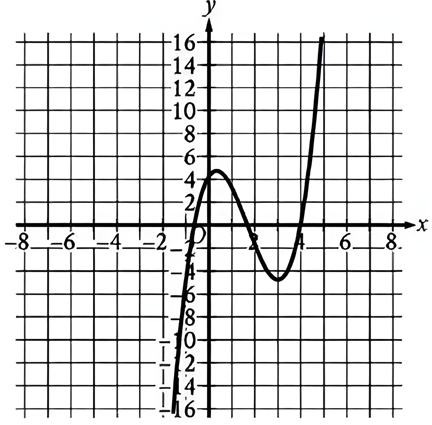
\(\begin{aligned}&\text{The graph of }y=f(x)-k\text{ is shown in the }xy\text{-plane. If }k,a,\mathrm{~and~}b\text{ are positive constants},\\&\text{which equation could define }f?\end{aligned}\)
CorrectIncorrect