Volumes and Surface Area
Quiz Summary
0 of 46 Questions completed
Questions:
Information
You have already completed the quiz before. Hence you can not start it again.
Quiz is loading…
You must sign in or sign up to start the quiz.
You must first complete the following:
Results
Results
0 of 46 Questions answered correctly
Your time:
Time has elapsed
You have reached 0 of 0 point(s), (0)
Earned Point(s): 0 of 0, (0)
0 Essay(s) Pending (Possible Point(s): 0)
Categories
- Not categorized 0%
- 1
- 2
- 3
- 4
- 5
- 6
- 7
- 8
- 9
- 10
- 11
- 12
- 13
- 14
- 15
- 16
- 17
- 18
- 19
- 20
- 21
- 22
- 23
- 24
- 25
- 26
- 27
- 28
- 29
- 30
- 31
- 32
- 33
- 34
- 35
- 36
- 37
- 38
- 39
- 40
- 41
- 42
- 43
- 44
- 45
- 46
- Current
- Review / Skip
- Answered
- Correct
- Incorrect
-
Question 1 of 46
1. Question
\(\begin{aligned}
\text{A cube has an edge length of 41 inches. What is the volume, in cubic inches, of the cube?}
\end{aligned}\)CorrectIncorrect -
Question 2 of 46
2. Question
\(\begin{aligned}
&\text{The length of each edge of a box is 29 inches. Each side of the box is in the shape of a square. }\\
&\text{The box does not have a lid. What is the exterior surface area, in square inches, of this box}\\&\text{without a lid?}\end{aligned}\)CorrectIncorrect -
Question 3 of 46
3. Question
\(\begin{aligned}&\text{The length of each edge of a box is 94 centimeters. Each side of the box is in the shape of a}\\&\text{square. The box does not have a lid. What is the exterior surface area, in square }\underline{\text{meters}},\text{ of}\\&\text{this box without a lid? (1 meter = 100 centimeters)}\end{aligned}\)
CorrectIncorrect -
Question 4 of 46
4. Question
\(\begin{aligned}
&\text{The surface area of a cube is 6}\left(\frac{a}{4}\right)^{2},\text{where }a\text{ is a positive constant.}\\
&\text{Which of the following gives the perimeter of one face of the cube?}\\\end{aligned}\)CorrectIncorrect -
Question 5 of 46
5. Question
\(\begin{aligned}
&\text{To study fluctuations in the leaf water potential, samples of wood were taken from 26 trees and}\\
&\text{cut in the shape of a cube. The length of the edge of one of these cubes is 2.00 centimeters. If}\\
&\text{this cube has a mass of 5.12 grams, what is the density of this cube in grams per cubic }\\
&\mathrm{centimeter?}\end{aligned}\)CorrectIncorrect -
Question 6 of 46
6. Question
\(\begin{aligned}
&\text{A cube has a volume of }79,507\text{ cubic units. What is the surface area, in square units, of}\\
&\text{the cube?}\end{aligned}\)CorrectIncorrect -
Question 7 of 46
7. Question
\(\begin{aligned}&\text{The edge length, in inches, of cube Y is }\frac{3}{64}\text{ the edge length, in inches, of cube X. The surface}\\&\text{area, in square inches, of cube Y is }n\text{ times the surface area, in square inches, of cube X.}\\&\text{What is the value of }n?\\\end{aligned}\)
CorrectIncorrect -
Question 8 of 46
8. Question
\(\begin{aligned}
&\text{What is the volume, in cubic centimeters, of a right rectangular prism that has a length of 4}\\
&\text{centimeters, a width of 9 centimeters, and a height of 10 centimeters?}\end{aligned}\)CorrectIncorrect -
Question 9 of 46
9. Question
\(\begin{aligned}
&\text{A right rectangular prism has a length of 26 centimeters (cm), a width of 16 cm, and a }\\
&\text{height of 14 cm. What is the surface area, in cm} ^{2},\text{ of the right rectangular prism?}\end{aligned}\)CorrectIncorrect -
Question 10 of 46
10. Question
\(\begin{aligned}
&\text{A granite block in the shape of a right rectangular prism has dimensions 30 centimeters by} \\
&\text{40 centimeters by 50 centimeters. The block has a density of 2.8 grams per cubic centimeter.}\\
&\text{What is the mass of the block, in grams? (Density is mass per unit volume.)}\end{aligned}\)CorrectIncorrect -
Question 11 of 46
11. Question
\(\begin{aligned}
&\text{A raised garden is in the shape of a right rectangular prism. Its base has a}\\
&\text{width of 3 feet and a length of 27 feet, and it will be filled 24 }\underline{\text{inches}}\text{ high with}\\
&\text{topsoil. The total cost of the topsoil needed to fill the garden to this height is}\\
&\text{234 dollars. What is the unit cost, in dollars per }\underline{\text{cubic yard}}\text{, for the topsoil?}\\&(1\text{ yard}=3\text{ feet};1\text{ foot}=12\text{ inches})\end{aligned}\)CorrectIncorrect -
Question 12 of 46
12. Question
\(\begin{aligned}&\text{The volume of a right rectangular prism with a square base is 539 cubic centimeters. If the}\\&\text{area of each of the four lateral faces is 77 square centimeters, what is the height, in}\\&\text{centimeters, of the prism?}\end{aligned}\)
CorrectIncorrect -
Question 13 of 46
13. Question
\(\begin{aligned}
&\text{The volume of a right rectangular prism with a square base is 1,792 cubic centimeters. If}\\
&\text{the area of the square base is 64 square centimeters, what is the area, in square centimeters, }\\
&\text{of one of the four lateral faces of the prism?}\\
\end{aligned}\)CorrectIncorrect -
Question 14 of 46
14. Question
\(\begin{aligned}&\text{A right rectangular prism has a base area of 56}t\text{ square centimeters (cm}^2).\text{ The length of}\\&\text{the base of the rectangular prism is }\frac{14}{3}\text{ cm, and the height of the rectangular prism is 3 cm }.\\&\text{Which expression represents the surface area, in cm}^2,\text{of the rectangular prism ?}\end{aligned}\)
CorrectIncorrect -
Question 15 of 46
15. Question
\(\begin{aligned}
&\text{A right rectangular prism has a base area of }28p\text{ square centimeters }\left(\mathrm{cm}^2\right).\text{The length of}\\
&\text{the base of the rectangular prism is 12 cm, and the height of the rectangular prism is 4 cm.}\\
&\text{Which expression represents the surface area, in cm}^2,\text{of the right rectangular prism?}\end{aligned}\)CorrectIncorrect -
Question 16 of 46
16. Question
\(\begin{aligned}
&\text{Two identical rectangular prisms each have a height of 90 centimeters (cm).}\\
&\text{The base of each prism is a square, and the surface area of each prism is }K \text{ cm}^ 2.\\
&\text{If the prisms are glued together along a square base,}\text{ the resulting prism has a }\\
&\text{surface area of }\frac{92}{47}K\text{ cm}^{2}.\text{ What is the side length, in cm, of each square base?}\end{aligned}\)CorrectIncorrect -
Question 17 of 46
17. Question
\(\begin{aligned}
&\text{Right rectangular prism X is similar to right rectangular prism Y. The surface area of right}\\
&\text{rectangular prism X is 58 square centimeters (cm}^{2}),\text{ and the surface area of right}\\
&\text{rectangular prism Y is 1,450 cm}^{2}.\text{ The volume of right rectangular prism Y is}\\
&\text{1,250 cubic centimeters (cm}^3).\text { What is the sum of the volumes, in cm}^3,\text{ of right }\\
&\text{rectangular prism X and right rectangular prism Y?}\end{aligned}\)CorrectIncorrect -
Question 18 of 46
18. Question
\(\begin{aligned}
&\text{A triangular prism has a height of 9 centimeters (cm) and a volume of 234 cm}^3.\text{ What is}\\
&\text{the area, in cm}^2,\text{of the base of the prism? (The volume of a triangular prism is equal to }Bh,\\&\text{where }B\text{ is the area of the base and }h\text{ is the height of the prism.})\end{aligned}\)CorrectIncorrect -
Question 19 of 46
19. Question
\(\begin{aligned}
&\text{The points }(0, 15),~(10, 8), \text{ and }(10,3)\text{ are shown in the }xy\text{-plane, where the }x \text{ and } y\text{-axis }\\
&\text{are measured in units.}\end{aligned}\)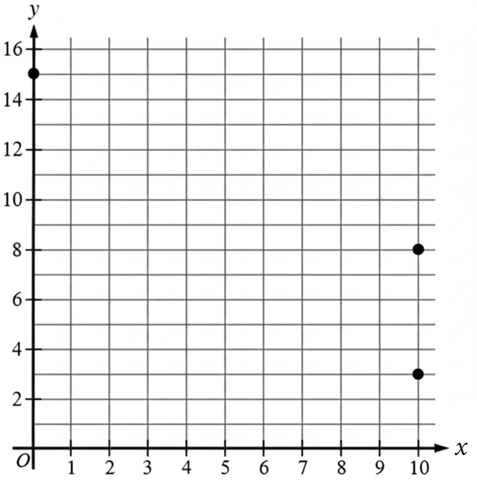
\(\begin{aligned}&\text{Three points define one of the bases of a triangular prism. The distance between the two}\\&\text{bases of the prism is 20 units. What is the volume, in cubic units, of the prism?}\end{aligned}\)
CorrectIncorrect -
Question 20 of 46
20. Question
\(\begin{aligned}
&\text{A right circular cylinder has a height of 6 inches. The radius of the base of the cylinder}\\
&\text{is 5 inches. What is the volume, in cubic inches, of the cylinder?}\end{aligned}\)CorrectIncorrect -
Question 21 of 46
21. Question
\(\begin{aligned}
&\text{A cylinder has a diameter of 14 inches and a height of 8 inches. What is the volume, in cubic}\\&\text{inches, of the cylinder?}\end{aligned}\)CorrectIncorrect -
Question 22 of 46
22. Question
\(\begin{aligned}
&\text{A right circular cylinder has a radius of 12 centimeters and a volume of }2,448\pi \text{ cubic centimeters.}\\
&\text{What is the height, in centimeters, of the cylinder?}\end{aligned}\)CorrectIncorrect -
Question 23 of 46
23. Question
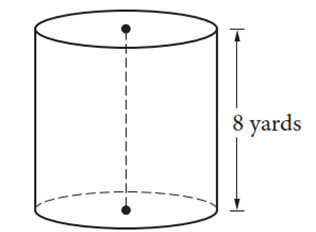 \(\begin{aligned}
&\text{A dairy farmer uses a storage silo that is in the shape of the right circular cylinder above.}\\
&\text{If the volume of the silo is }72\pi\text{ cubic yards, what is the }\underline{\text{diameter}}\text{ of the base of the cylinder,}\\&\text{in yards?}\end{aligned}\)CorrectIncorrect -
Question 24 of 46
24. Question
\(\begin{aligned}
&\text{The circumference of the base of a right circular cylinder is }6\pi\text{ meters, and the height}\\
&\text{of the cylinder is 19 meters. What is the volume, in cubic meters, of the cylinder?}\end{aligned}\)CorrectIncorrect -
Question 25 of 46
25. Question
\(\begin{aligned}
&\text{The height of a right circular cylinder is 6 inches longer than its radius, and the surface area}\\
&\text{of the cylinder is 1,080}\pi\text{ square inches. What is the cylinder’s radius, in inches?}\end{aligned}\)CorrectIncorrect -
Question 26 of 46
26. Question
\(\begin{aligned}
&\text{The volume of right circular cylinder A is 22 cubic centimeters. What is the volume, in cubic}\\
&\text{centimeters, of a right circular cylinder with twice the radius and half the height of cylinder A?}\\
\end{aligned}\)CorrectIncorrect -
Question 27 of 46
27. Question
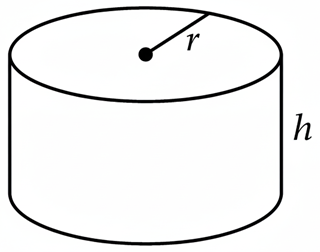
\(\begin{aligned}
&\text{The figure shown is a right circular cylinder with a radius of }r\text{ and a height of }h.\text{ A second}\\
&\text{right circular cylinder (not shown) has a volume that is 576 times as large as the volume of}\\
&\text{the cylinder shown. Which of the following could represent the radius }R,\text{ in terms of }r,\text{ and}\\
&\text{the height }H,\text{ in terms of }h,\text{ of the second cylinder?}\end{aligned}\)CorrectIncorrect -
Question 28 of 46
28. Question
\(\begin{aligned}
&~~~~~~~~~~~~~~~~~\begin{array}{|c|c|}\hline\\&~\text{ Volume (cubic units) }~\\\\\hline~~\\\text{Right circular cylinder A}~~&112\pi\\\\\hline~~\\\text{ Right circular cylinder B }~~&3,024\pi\\\\\hline\end{array}\\\\
&\text{The table shows the volume of two similar solids, right circular cylinder A }\\
&\text{and right circular cylinder B. The radius of right circular cylinder A is 4 units.}\\
&\text{The surface area of right circular cylinder A is }k\pi\text{ square units, and the}\\
&\text{surface area of right circular cylinder B is }n\pi\text{ square units, where }k\text{ and }n\\
&\text{are constants. What is the value of }n-k?\text{ (The surface area of a right }\\&\text{radius }r\text{ and height }h\mathrm{~is~}2\pi r^{2}+2\pi rh.)\end{aligned}\)CorrectIncorrect -
Question 29 of 46
29. Question
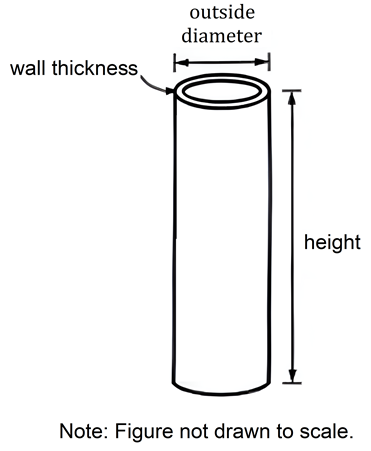
\(\begin{aligned}&\text{In the figure, a hollow steel pipe is in the shape of a right circular cylinder. The steel pipe has an outside}\\&\text{diameter of 48 inches, a wall thickness of }\frac{3}{8}\text{ inches, and a height of 138 inches. Which of the following is}\\&\text{closest to the volume, in cubic inches, of the wall of this steel pipe?}\end{aligned}\)
CorrectIncorrect -
Question 30 of 46
30. Question
\(\begin{aligned}
&\text{A right circular cone has a height of 13 centimeters (cm) and a base with a radius of 6 cm.}\\
&\text{What is the volume, in cm}^{3}\text{, }\text{of this cone?}\end{aligned}\)CorrectIncorrect -
Question 31 of 46
31. Question
\(\begin{aligned}
&\text{A right circular cone has a base diameter of 28 inches and a height of 6 inches. The}\\
&\text{volume of this cone is }k\pi\text{ cubic inches. What is the value of }k?\end{aligned}\)CorrectIncorrect -
Question 32 of 46
32. Question
\(\begin{aligned}
&\text{A right circular cone has a volume of }24\pi\text{ cubic inches. If the height of the cone is 2 inches,}\\
&\text{what is the radius, in inches, of the base of the cone?}\end{aligned}\)CorrectIncorrect -
Question 33 of 46
33. Question
\(\begin{aligned}
&\text{A right circular cone has a volume of }2,700\pi\text{ cubic centimeters and the area of its base }\\
&\text{is }225\pi\text{ square centimeters. What is the slant height, in centimeters, of this cone?}\end{aligned}\)CorrectIncorrect -
Question 34 of 46
34. Question
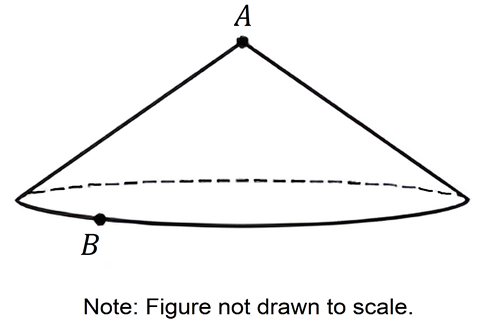
\(\begin{aligned}
&\text{For the right circular cone shown, }B\text{ is a point on the circumference of the base, and the}\\
&\text{length of segment }AB\text{ (not shown) is 84 centimeters. If the height of the cone is 42}\\
&\text{centimeters and the volume of the cone is }k\pi\text{ cubic centimeters, what is the value of }k?
\end{aligned}\)CorrectIncorrect -
Question 35 of 46
35. Question
\(\text{A sphere has a radius of }\frac{8}{3}\text{ feet. What is the volume, in cubic feet, of the sphere?}
\)CorrectIncorrect -
Question 36 of 46
36. Question
\(\begin{aligned}
&\text{The density of a certain type of marble stone is 2.6000 grams per cubic centimeter. If a }\\
&\text{sample of this type of stone is in the shape of a sphere with a diameter of 31.000 }\\
&\text{centimeters, what is the mass of this sample, in grams, to the nearest whole number? (Use}\\&\text{3.14159 for }\pi.)\end{aligned}\)CorrectIncorrect -
Question 37 of 46
37. Question
\(\begin{aligned}&\text{A hemisphere is half of a sphere. If a hemisphere has a radius of 69 inches, which of the}\\
&\text{following is closest to the volume, in cubic inches, of this hemisphere?}\end{aligned}\)CorrectIncorrect -
Question 38 of 46
38. Question
\(\begin{aligned}
&\text{A cube has an edge length of 68 inches. A solid sphere with a radius of 34 inches is inside the cube}\\
&\text{such that the sphere touches the center of each face of the cube. To the nearest cubic inch, what is }\\
&\text{the volume of the space in the cube }\underline{\text{not}}\text{ taken up by the sphere?}\end{aligned}\)CorrectIncorrect -
Question 39 of 46
39. Question
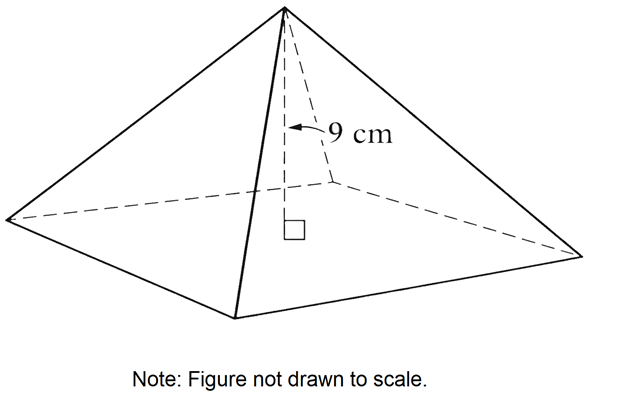
\(\begin{aligned}&\text{The right square pyramid shown has a height of 9 centimeters (cm). The length, in cm, of}\\&\text{one edge of the pyramid’s base is }\frac{13}{3}\text{ times the height of the pyramid. What is the volume,}\\&\text{in cm}^3\text{, of the pyramid}?\end{aligned}\)
CorrectIncorrect -
Question 40 of 46
40. Question
\(\begin{aligned}
&\text{A right square pyramid has a height of 12 inches and a volume of 1,296 cubic inches.}\\
&\text{What is the perimeter, in inches, of the base of this pyramid?}\end{aligned}\)CorrectIncorrect -
Question 41 of 46
41. Question
\(\begin{aligned}
&\text{A right square pyramid has a height of 11 centimeters (cm). A second right square pyramid}\\
&\text{has a height of 22 centimeters. The area of the base of each of the two pyramids is 100 cm}^{2}.\\
&\text{Which of the following is closest to the difference in the surface area of the second pyramid}\\
&\text{and the surface area of the first pyramid, in cm}^{2}~?\end{aligned}\)CorrectIncorrect -
Question 42 of 46
42. Question
\(\begin{aligned}
&\text{A right square pyramid has a surface area of }100+20\sqrt{146}\text{ square inches, which includes}\\
&\text{a base area of 100 square inches. What is the height, in inches, of this pyramid?}\end{aligned}\)CorrectIncorrect -
Question 43 of 46
43. Question
\(\begin{aligned}
&\text{A right square pyramid has a total surface area of 70,560 square inches, and the combined}\\
&\text{surface area of the four lateral faces of this pyramid is 38,160 square inches. What is the}\\
&\text{height, in inches, of this pyramid?}\end{aligned}\)CorrectIncorrect -
Question 44 of 46
44. Question
\(\begin{aligned}&\text{A right square pyramid has a surface area of 75,264 square inches, which includes a base}\\&\text{area of 36,864 square inches. What is the slant height, in inches, of this pyramid?}\end{aligned}\)
CorrectIncorrect -
Question 45 of 46
45. Question
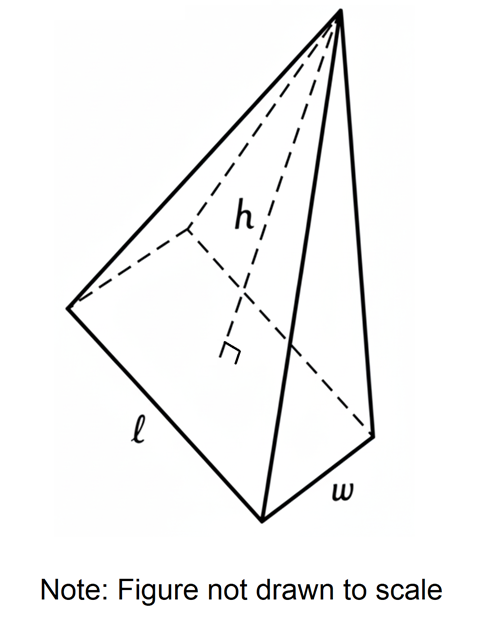
\(\begin{aligned}
&\text{The figure shown is a right rectangular pyramid, where }\ell=18\text{ units},w=9\text{ units},\\
&\text{and }h=12\text{ units. What is the surface area, in square units, of the pyramid?}\end{aligned}\)CorrectIncorrect -
Question 46 of 46
46. Question
\(\begin{aligned}
&\text{A right triangular pyramid has exactly six edges. Each of these edges is 96}\\
&\text{centimeters long. If the surface area of the pyramid is }k\sqrt{3}\text{ square}\\
&\text{centimeters, what is the value of }k?\end{aligned}\)CorrectIncorrect